How Do You Get Found in AI Search When Customers Ask ChatGPT, Not Google?
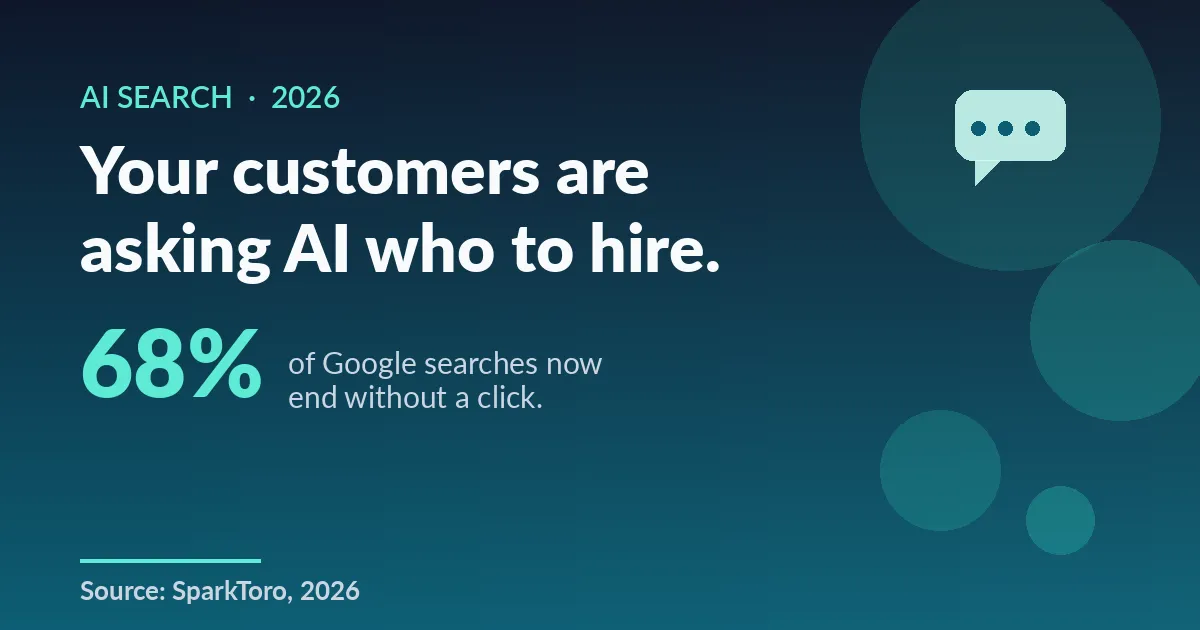
In 2026, 68% of Google searches end without a click. Here's how to get found in AI search when buyers ask ChatGPT and AI Overviews who to hire.
How Do You Get Found in AI Search When Customers Ask ChatGPT, Not Google?
Your next customer may never see your website. In 2026, 68% of US Google searches ended without a single click, up from 60% two years earlier (SparkToro, retrieved 2026-07-24). More people now type a question, read the AI’s answer, and stop. So the real question for any business owner isn’t “where do I rank?” It’s simpler and scarier: when someone asks an AI who to hire, does your name come up? This guide explains how to get found in AI search, in plain terms, without the jargon.
Key Takeaways
- In 2026, 68% of Google searches end without a click (SparkToro), so being the cited answer matters more than the blue link.
- AI assistants recommend businesses they can clearly identify and verify — a consistent name, clear services, and third-party proof.
- More software won’t save you; clarity, real proof, and genuinely human content will.
What Does “Getting Found in AI Search” Actually Mean?
Getting found in AI search means your business shows up inside the answer an assistant gives, not just on a results page nobody clicks. In 2026, 68% of Google searches ended with no click at all (SparkToro, retrieved 2026-07-24). That number was about 60% in 2024. The gap is your customers reading AI Overviews and chatbot replies instead of visiting sites.
Think about how you search now. You ask ChatGPT or Google’s AI for “the best bookkeeper near me” or “a good agency for a small clinic.” You get a short list. You rarely scroll ten blue links anymore. Your customers do exactly the same thing.
So “ranking” is only half the job now. The other half is being the answer. For a deeper look at how classic rankings and AI answers work together, see [INTERNAL-LINK: our beginner’s guide to modern SEO → pillar page on search visibility].
Why Is the Old SEO Playbook Losing Power?
The old playbook is losing power because winning position one no longer guarantees traffic. In 2025, Ahrefs studied 300,000 keywords and found that when a Google AI Overview appears, the top organic result gets about 34.5% fewer clicks (Ahrefs, retrieved 2026-07-24). You can rank first and still lose a third of your visitors to the answer box above you.
That doesn’t mean SEO is dead. It means the goal shifted. You used to write pages to earn a click. Now you also write pages to earn a mention inside the answer. SparkToro’s 2026 data puts a finer point on it: AI Overviews cut click-through by nearly 60% when they show up (SparkToro, retrieved 2026-07-24).
Our take: We’ve watched clients hold a number-one ranking while their traffic slid quarter after quarter. The ranking was fine. The click was gone. If you only measure position, you’ll miss this happening to you.
The fix isn’t to chase the algorithm harder. It’s to write content an AI can quote cleanly and attribute to you. Short, clear answers near the top of each page do most of that work. Want the exact page structure we use? See [INTERNAL-LINK: our answer-first content template → guide on writing citable pages].
How Do AI Assistants Decide Who to Recommend?
AI assistants recommend businesses they can clearly identify, understand, and verify from more than one source. There’s no secret ranking dial. These systems pull from the open web, and they favor names that appear consistently, with clear services and outside proof. If a model can’t tell what you do or where you operate, it won’t risk recommending you.
Here’s the part most owners miss. An AI doesn’t “trust” a slick homepage. It trusts patterns across the internet: matching business details on your site, your Google Business Profile, directories, and reviews. When those line up, you become a safe, confident answer. When they conflict — old address here, different phone there — you become a guess the model would rather skip.
Our take: The businesses getting recommended aren’t the loudest. They’re the clearest. One consistent name, one clear list of services, one honest description of who you help. Do that across every profile and you’ve done more for AI visibility than a month of clever tricks.
Three practical moves help right away:
- Say plainly what you do, who you serve, and where, on your homepage and your Google Business Profile.
- Keep your business name, address, and phone identical everywhere they appear.
- Earn real reviews and mentions on sites the AI already reads.
For the profile side of this, see [INTERNAL-LINK: our local presence checklist → guide on Google Business Profile setup].
More Marketing Software Won’t Fix This
More software will not fix this, and the numbers show why. The 2026 martech landscape now maps 15,505 tools, yet 90.3% of teams say they use AI agents somewhere while only 23.3% run them in full production (MarTech, retrieved 2026-07-24). Most teams are buying tools they never fully use. Adding another dashboard rarely moves the needle.
What actually works is boring and effective: fix the basics an AI reads, publish clear proof of your work, and keep your details consistent. That’s cheaper than most subscriptions and it lasts. If you’d rather spend on one thing, spend on clarity — not another tool. For help choosing where to invest, see [INTERNAL-LINK: our marketing budget guide → article on prioritizing spend for small businesses].
Why Does “Obviously AI” Content Backfire?
“Obviously AI” content backfires because people have grown tired of it fast, and that fatigue is now measurable. Meltwater found that online mentions of “AI slop” rose roughly nine-fold from 2024 to 2025 — from about 461,000 to 2.4 million — with negative sentiment peaking near 54% (Meltwater, retrieved 2026-07-24). Readers can smell generic, mass-produced text, and it costs you trust.
There’s a real irony here. To get recommended by AI, your best move is to sound less like AI. Share the specific things only you know: a client’s before-and-after, a mistake you fixed, a number from your own work. Those details are what a model can’t invent, and they’re what makes your page worth quoting. Use AI to draft and speed things up, sure — then add the human proof that makes it yours.
What Should You Do in the Next 90 Days?
In the next 90 days, focus on clarity, proof, and consistency — the three things AI systems reward. Start with the data you already own. As of Salesforce’s most recent State of Marketing survey, 84% of marketers now treat customer and first-party data as a top source, while reliance on third-party data keeps falling (MarTech, retrieved 2026-07-24). Your own customer list, reviews, and results are your strongest asset.
A simple 90-day plan:
- Weeks 1–2: Write one clear sentence for each service you offer, in plain language a stranger understands. Put it on your homepage.
- Weeks 3–4: Match your business name, address, and phone across your site, Google Business Profile, and every directory.
- Weeks 5–8: Publish two or three short, honest case studies with real numbers and a clear answer at the top of each page.
- Weeks 9–12: Ask happy customers for reviews, and answer the questions people actually ask you, one page per question.
None of this needs a big budget. It needs your real knowledge, written down clearly. B2B buyers already lean on these tools to shortlist vendors: Forrester reports that over 90% of buyers who used generative AI to inform large purchases said it helped (Forrester, retrieved 2026-07-24). Being clear and verifiable is how you land on that shortlist.
Ready to Become the Answer, Not Just a Result?
If this feels like a lot, you don’t have to sort it alone. At Rumeira, we help small and midsize businesses get found in AI search by fixing the basics that AI systems read, then building the clear, human content that earns the mention. Start with a free visibility check: we’ll tell you, in plain terms, whether an AI can confidently recommend you today — and what to fix first.
Frequently Asked Questions
What is AI search, in simple terms?
AI search is when a person asks a tool like ChatGPT, Google AI Overviews, Perplexity, or Gemini a question and reads the answer directly. In 2026, 68% of Google searches ended without a click (SparkToro), so the answer often replaces the visit to your site.
Do I still need a website and SEO?
Yes. AI systems build their answers from the open web, including your site. Ranking still matters, but the goal has widened: you now want to be quoted inside the answer, not only listed below it. Ahrefs found an AI Overview cuts the top result’s clicks by about 34.5% (Ahrefs).
How long does it take to get found in AI search?
There’s no fixed timeline, and anyone promising overnight results is guessing. Most businesses see movement over one to three months of consistent work: clear service descriptions, matching details everywhere, and real proof. The basics compound, and they hold up better than chasing algorithm tricks.
Will using AI to write my content hurt me?
Not by itself. The problem is generic, obviously-automated text. Mentions of “AI slop” rose about nine-fold from 2024 to 2025 (Meltwater). Use AI to draft, then add the specific numbers, stories, and proof only you have. That’s what earns trust and citations.
The Bottom Line
Search changed under our feet. When most people read the answer instead of clicking, the winners are the businesses an AI can confidently recommend. That’s less about tricks and more about clarity: say plainly what you do, keep your details consistent, and back it with real proof only you can offer. Do that, and you stop competing for a click nobody makes — and start becoming the answer. For your next step, see [INTERNAL-LINK: our free AI visibility checklist → downloadable checklist for getting cited by AI].
Sources
- SparkToro (Rand Fishkin), “In 2026, Less than One Third of Google Searches Still Send a Click,” 2026 — retrieved 2026-07-24, https://sparktoro.com/blog/in-2026-less-than-one-third-of-google-searches-still-send-a-click/
- Ahrefs (Ryan Law & Xibeijia Guan), “AI Overviews Reduce Clicks by 34.5%,” 2025 — retrieved 2026-07-24, https://ahrefs.com/blog/ai-overviews-reduce-clicks/
- MarTech (Frans Riemersma), “Martech 2026: AI drives a major industry reset,” 2026 — retrieved 2026-07-24, https://martech.org/martech-2026-ai-drives-a-major-industry-reset/
- Meltwater, “What the Rise of AI Slop Means for Marketers,” 2025 — retrieved 2026-07-24, https://www.meltwater.com/en/blog/ai-slop-consumer-sentiment-social-listening-analysis
- MarTech, “61% of marketers still relying on third-party data” (Salesforce State of Marketing), 2024 — retrieved 2026-07-24, https://martech.org/61-of-marketers-still-relying-on-third-party-data/
- Forrester, “Predictions 2025: Younger Business Buyers And GenAI Will Upend The Status Quo,” 2024 — retrieved 2026-07-24, https://www.forrester.com/blogs/predictions-2025-business-buyers/